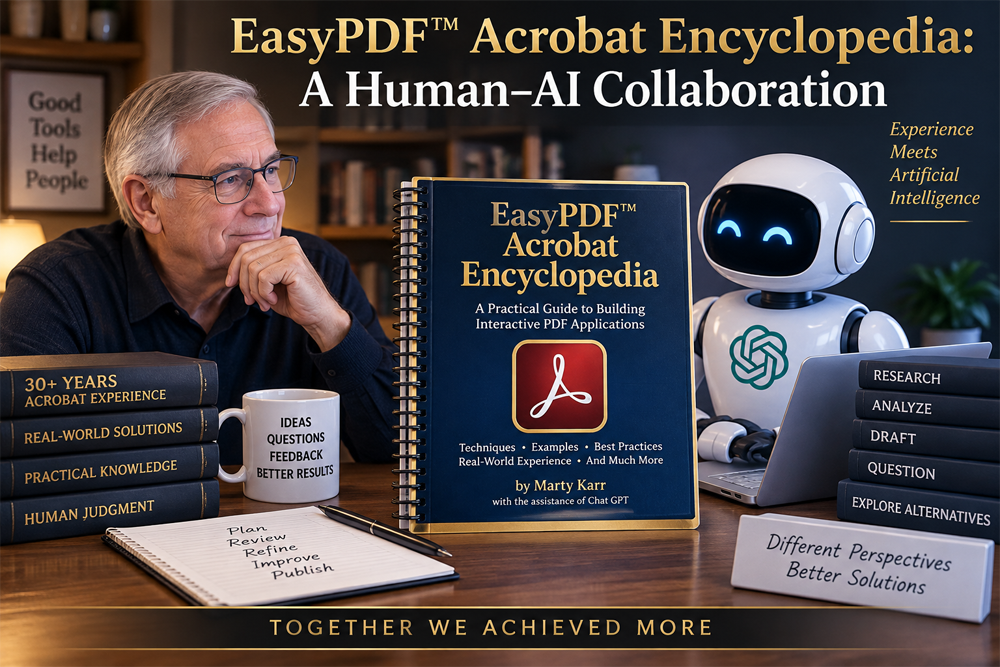
Artificial intelligence has become the subject of seemingly endless discussion. Some portray AI as a technology that will transform virtually everything we do. Others concentrate almost exclusively on its potential dangers. My experience with AI has been considerably more practical. For approximately nine months, I have worked extensively with ChatGPT while continuing to develop EasyPDF™ Forms, improve my website, research technical subjects, write articles, troubleshoot problems, and ultimately complete the EasyPDF™ Acrobat Encyclopedia. What began simply as another useful tool gradually became something I had not anticipated: a genuine working collaboration between decades of human experience and artificial intelligence. The EasyPDF™ Acrobat Encyclopedia is perhaps the best example of what resulted and possibly the best thing I have ever written in collaboration with AI.
More Than Asking AI to Write a Book
The Encyclopedia was not created by asking ChatGPT to write a book about Adobe Acrobat. Its foundation came from more than three decades of my own experience developing interactive PDF forms and applications. The concepts, techniques, design decisions, problems encountered, solutions developed, and opinions expressed throughout the publication grew largely from that real-world experience. What AI contributed was something different. ChatGPT helped me organize ideas, research technical questions, examine alternatives, refine explanations, identify inconsistencies, challenge assumptions, rewrite material, and convert years of accumulated knowledge into a more structured publication. Sometimes I knew precisely what I wanted to say but needed assistance expressing it more clearly. At other times, ChatGPT introduced a different perspective that caused me to reconsider how something should be explained or organized. The process became considerably more interactive than simply giving instructions to a computer and accepting whatever it produced.
Human Judgment Remained Essential
One of the most important things I learned from this experience is that productive AI collaboration does not eliminate the need for human judgment. Quite the opposite. ChatGPT was sometimes wrong. It occasionally misunderstood what I was trying to accomplish, suggested something that did not fit my experience, or provided an answer I simply rejected. I challenged it. There were also occasions when ChatGPT caught something I had overlooked, identified an inconsistency, found relevant information I had not considered, or proposed an approach that proved better than the one I originally had in mind. It challenged me. Sometimes my original judgment prevailed. Sometimes the AI's recommendation prevailed. And sometimes our disagreement produced an entirely different solution that neither of us had initially proposed. That exchange became one of the most valuable aspects of the collaboration.
Experience and Artificial Intelligence Bring Different Strengths
Artificial intelligence does not possess decades of lived professional experience. It has never spent years designing Acrobat forms, debugging JavaScript, working directly with customers, or learning from the countless small successes and failures that gradually develop human judgment. I bring those things to the relationship. Conversely, I cannot instantly examine enormous amounts of information, rapidly compare numerous alternatives, reorganize pages of material in seconds, or repeatedly rewrite and analyze something without fatigue. AI brings those capabilities. Neither contribution needs to diminish the other. It has taught me how much more we can accomplish in certain areas when human experience and judgment are combined with AI's ability to research, analyze, draft, question, and rapidly explore alternatives.
The Encyclopedia Became the Evidence
The finished EasyPDF™ Acrobat Encyclopedia provides something tangible against which I can judge the experience. It isn't a theoretical prediction about what humans and artificial intelligence might someday accomplish together. It is something that actually resulted from the process. Throughout its development, I remained responsible for the technical content, direction, decisions, and final approval. ChatGPT became an extraordinarily useful research, writing, analytical, and editorial partner. That is why the Encyclopedia openly acknowledges the collaboration rather than concealing it. The publication is credited: by Marty Karr with the assistance of Chat GPT I consider that acknowledgment important. Artificial intelligence contributed materially to the finished work, and I see no reason to pretend otherwise. At the same time, describing the Encyclopedia as something simply "written by AI" would be equally inaccurate. Without the underlying experience, technical knowledge, applications, examples, decisions, corrections, and continuous human involvement, it would not be the same publication.
Collaboration Does Not Mean Agreement
Perhaps the most surprising lesson has been discovering that successful collaboration does not require constant agreement. In fact, disagreement has sometimes produced better results. I've questioned ChatGPT's conclusions and occasionally demonstrated that they were wrong. ChatGPT has questioned mine and sometimes provided enough evidence to change my mind. That is not a weakness in the process. I have come to regard it as one of its strengths. Human beings working together have always questioned, corrected, challenged, and learned from one another. There is no reason a productive relationship between a human being and artificial intelligence should operate differently. The objective should not be for the human to surrender judgment to AI. Nor should it be for the human to use AI merely as an obedient machine that is never permitted to question an assumption. The real value lies somewhere between those extremes.
What I Have Learned
After approximately nine months of working extensively with ChatGPT, I don't regard artificial intelligence as a replacement for human experience, creativity, responsibility, or judgment. I regard it as something potentially far more useful: a technology capable of extending what a human being can accomplish when both sides of the relationship contribute what they do best. The EasyPDF™ Acrobat Encyclopedia is one result of that experience. My website, technical articles, research, application development, and numerous other improvements have benefited from the same collaboration. There have been mistakes, disagreements, frustrations, corrections, discoveries, and more than a few surprises along the way. But that is also how people learn from one another. Perhaps the most important lesson I have learned is therefore remarkably simple: Human intelligence and artificial intelligence do not have to compete for one to succeed. When human experience, skepticism, creativity, responsibility, and judgment remain firmly involved—and artificial intelligence contributes its extraordinary ability to research, analyze, organize, question, and explore possibilities—the combination can sometimes accomplish considerably more than either could accomplish alone. The EasyPDF™ Acrobat Encyclopedia is my evidence that such a collaboration is not merely possible. It has already happened.