Adobe Acrobat's Most Overlooked PDF Application Platform
Have We Been Looking at Interactive PDF Applications the Wrong Way?
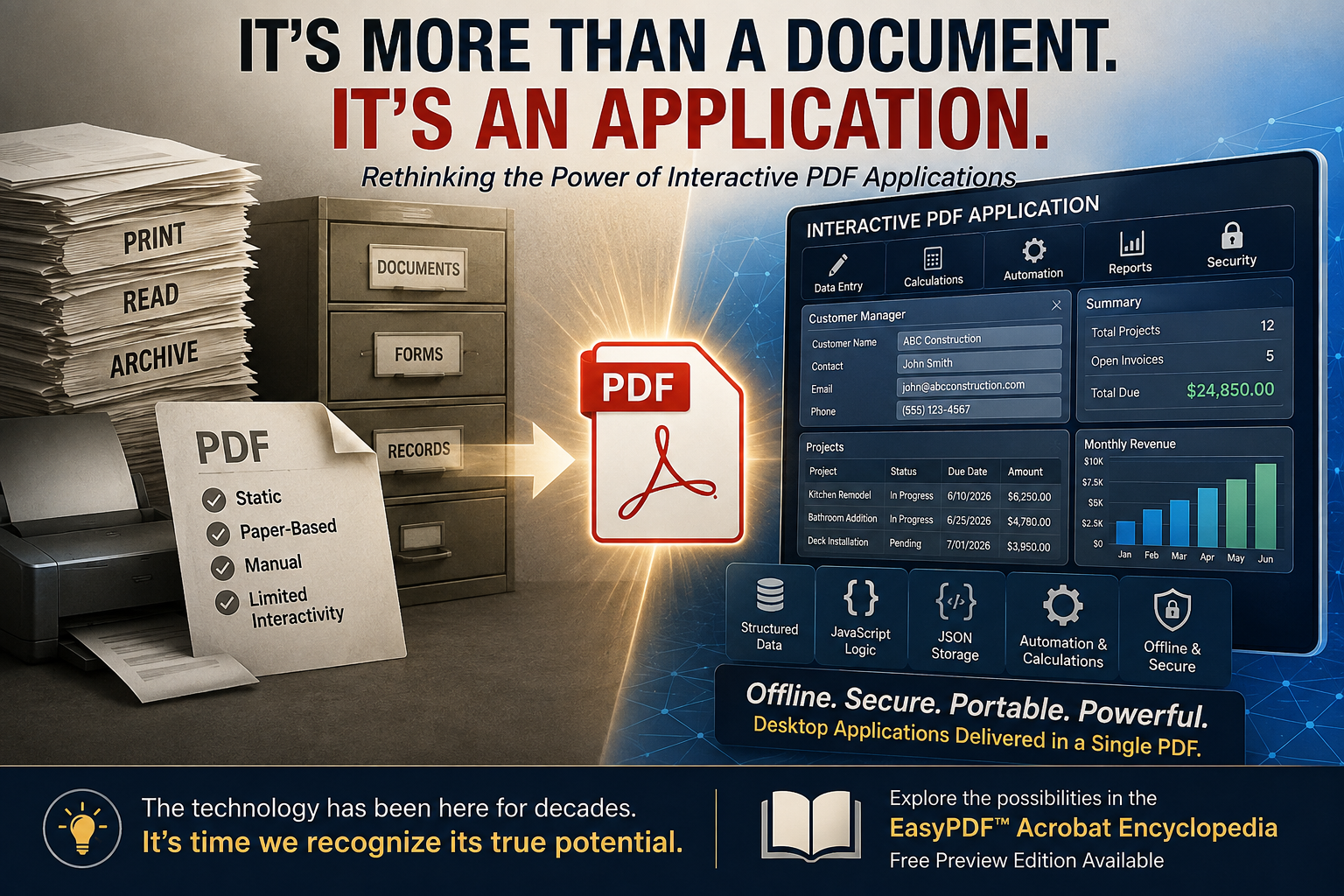
For years, the software industry has largely portrayed PDF documents as little more than electronic paper—excellent for reading, printing, signing, sharing, and archiving information. That perception isn't wrong. It simply isn't the entire story. While developers increasingly embraced cloud computing, subscription software, browser-based applications, and online collaboration, another technology quietly continued evolving in the background, largely unnoticed. That technology was Adobe Acrobat. More specifically, interactive PDF applications powered by Acrobat JavaScript. Unfortunately, somewhere along the way, many developers and software professionals came to view Acrobat as merely a tool for creating electronic forms rather than a surprisingly capable application development platform. I believe that perception deserves to be reconsidered.
Beyond Electronic Forms
When most people hear the phrase interactive PDF form, they typically imagine a digital version of a paper document containing text fields, check boxes, radio buttons, and perhaps a few calculations. That description accurately reflects how many PDF forms are created today. It does not describe what Acrobat is actually capable of becoming. Over the past three decades, I have developed commercial PDF applications ranging from password managers and digital Rolodex systems to customer management, estimating, invoicing, contractor documentation, and medication management applications. Although each solves a different problem, they all share one characteristic. None of them rely upon an external database. None require a cloud service. None require recurring subscriptions. Instead, each application stores and manages structured information entirely within the PDF itself through thoughtfully designed JavaScript objects, JSON data structures, hidden fields, reusable helper functions, and carefully engineered application architecture.
The Architectural Shift
The breakthrough was never discovering JavaScript objects. The breakthrough was recognizing that a JavaScript object can fulfill the same organizational role as a traditional database record. Once that relationship is understood, an entirely different way of thinking about interactive PDF development begins to emerge. Instead of asking, "How do I build a better form?" the question becomes, "How do I design a better application?" That single shift in perspective changes everything. Suddenly, familiar software engineering concepts such as modular design, business logic, reusable components, structured data, maintainability, and application architecture become directly applicable inside a single interactive PDF document.
A Different Perspective
None of this suggests that Acrobat should replace every web application or cloud service. Nor does it imply that browser-based software, online collaboration, or subscription platforms are inappropriate. Each serves important purposes. However, there remains an entire class of desktop applications that benefit enormously from being self-contained, portable, offline, and owned entirely by the user. For those applications, Acrobat continues to offer capabilities that are frequently overlooked. Ironically, while the software industry continued looking outward toward servers and cloud infrastructure, many developers stopped looking inward at what Acrobat had quietly become.
Why This Matters
Technology often advances by discovering something entirely new. Occasionally, however, progress occurs because someone simply looks at an existing technology from a different perspective. I believe interactive PDF applications represent one of those opportunities. The necessary technology has existed for many years. What has been largely missing is the architectural perspective needed to recognize its potential. That realization ultimately inspired the creation of EasyPDF™ Acrobat Encyclopedia—not simply to document Acrobat JavaScript, but to explore a different philosophy of designing interactive PDF applications. Perhaps the greatest untapped opportunity within Acrobat today is not another JavaScript technique. Perhaps it is recognizing that interactive PDF applications deserve to be viewed as a legitimate desktop application platform in their own right.
About the Author
Marty Karr is the creator of EasyPDF™ Forms and author of EasyPDF™ Acrobat Encyclopedia, a practical guide documenting more than three decades of experience designing sophisticated JavaScript-enhanced interactive PDF applications using Adobe Acrobat.